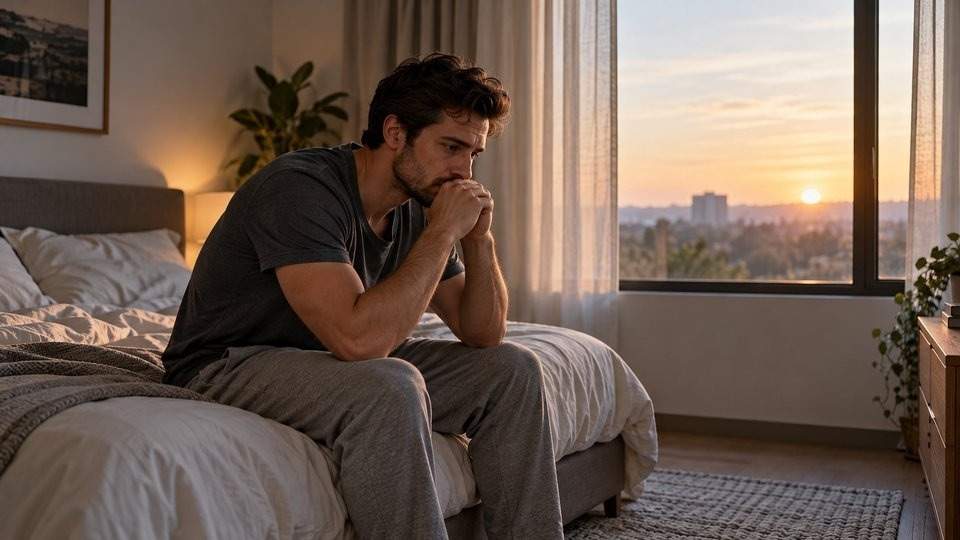
Anxiety the morning after drinking can be unsettling. Alcohol’s effects, disrupted sleep, physical discomfort and concerns about the previous night can all contribute. Understanding these possibilities can help you respond, but there is no single timetable or explanation for everyone.
If drinking and anxiety have started reinforcing each other, that is what dual diagnosis treatment is built to handle. This chapter sits inside the guide to mental health and substance use.
What follows covers the mechanism, the timeline, the question of whether alcohol is causing your anxiety or revealing it, what actually helps, and one medication warning that most pages on this subject leave out. It is written for people who are feeling anxious the morning after and want to know why, not for people hunting a hangover cure.
What Hangxiety Actually Is
Hangxiety is the informal name for anxiety during a hangover. It is not an official diagnosis. Symptoms can include worry, a racing heart, replaying conversations or difficulty concentrating. Physical discomfort and psychological stress may occur together, and severity and duration vary [1].
How Alcohol Affects the Brain’s Anxiety Circuits
Alcohol affects inhibitory and excitatory signaling in the brain. With repeated heavy use, adaptations can contribute to withdrawal-related anxiety. After an isolated drinking episode, anxiety may also reflect disrupted sleep, physical symptoms, and psychological stress; it should not automatically be described as alcohol withdrawal.
Alcohol Stimulates GABA
Gamma-aminobutyric acid, usually shortened to GABA, is the brain’s main inhibitory neurotransmitter. Alcohol can enhance GABA-related inhibition and affect several other signaling systems, contributing to disinhibition and sedation [2]. Feeling calmer temporarily does not make it an effective treatment for an anxiety disorder.
Alcohol can enhance inhibitory signaling and suppress some excitatory signaling. These effects can feel calming, but they do not make alcohol a reliable or safe treatment for anxiety.
The Rebound When Alcohol Wears Off
Repeated heavy drinking can lead to adaptations in inhibitory GABA and excitatory glutamate signaling. These adaptations help explain alcohol withdrawal when someone with physical dependence reduces or stops drinking [2].
In alcohol withdrawal, reduced inhibitory activity and increased excitation can contribute to anxiety, tremor, and more serious symptoms [2]. A hangover after an isolated episode can also involve a temporary rebound in anxious feelings [1], but the two situations should not be treated as interchangeable.
Why the Amygdala Matters
NIAAA describes heightened negative emotions during the addiction and withdrawal cycle, involving stress-related circuits in the extended amygdala [3]. This can include anxiety, irritability, and emotional distress.
Hyperkathexis describes heightened negative emotional states associated with the addiction and withdrawal cycle. That framework helps explain repeated heavy use, but it should not be applied as the sole explanation for every isolated hangover. Worry about events and other stressors can also contribute.
How Long Anxiety Lasts After Drinking
Hangover symptoms often become most noticeable as blood alcohol approaches zero and may last 24 hours or longer [1]. Anxiety has no fixed timetable. Withdrawal after prolonged heavy drinking is a different clinical issue and can require medical treatment.
A general pattern to watch for:
- Alcohol’s initial effects may feel sedating, while sleep can become more disrupted later
- Anxious feelings may appear as the effects wear off, with timing varying by the person and drinking pattern
- The next morning may bring anxiety alongside other hangover symptoms
- Symptoms may ease during the day, but can last 24 hours or longer
- After prolonged heavy use, symptoms may reflect withdrawal and need assessment rather than waiting for a hangover to pass
People with AUD can have persistent sleep disturbances during recovery [4]. That finding does not set a one-month recovery timetable after a single night of drinking. Seek assessment for ongoing sleep problems.
Why Some People Get It, and Others Do Not
- Existing anxiety symptoms, since the rebound lands on top of feelings that were already there
- Amount and pace of drinking, which affect intoxication and the likelihood of a hangover
- Repeated heavy drinking and a history of withdrawal, which can change the risk and severity of symptoms
- Poor sleep, since alcohol can disrupt sleep even when it initially helps you fall asleep
- Social context, where a night with real embarrassment in it gives the anxiety something to attach to
- Being someone who already experiences panic attacks, since the physical sensations can induce panic attacks in their own right
- A history of panic disorder or social phobia, both of which raise the odds that ordinary physical sensations get read as danger
People with existing anxiety or panic symptoms may find hangover sensations especially distressing. Responses differ, and severe or unfamiliar symptoms should not automatically be dismissed as an ordinary hangover.
Does Alcohol Cause Anxiety, or Reveal It?
This is the question underneath the search, and the honest answer is that it goes both ways and the distinction is clinically important rather than academic.
Substance-Induced Versus an Independent Anxiety Disorder
Alcohol can produce anxiety symptoms or worsen an independent anxiety disorder. Clinicians use the symptom history, drinking pattern, and periods of abstinence to distinguish them. NIAAA reports that AUD prevalence among people treated for anxiety disorders ranges from 20 to 40 percent [4]. Symptoms that persist need assessment rather than a self-diagnosis based only on when drinking stopped.
The Timeline Test
Clinicians use symptom history alongside assessment tools. They ask when anxiety and drinking began, what happened during periods of abstinence, and whether there is a family history [4].
Anxiety during extended abstinence can suggest an independent disorder, while symptoms tied closely to drinking may point toward alcohol-related effects. Neither pattern establishes a diagnosis by itself; persistent symptoms deserve assessment.
Alcohol and Anxiety as a Cycle
Another drink may temporarily mask discomfort, but it does not treat a hangover or anxiety disorder and can prolong the drinking pattern. Relying on alcohol for relief can reinforce harmful use. If symptoms suggest withdrawal, seek medical advice rather than trying to manage them with more alcohol.
When Drinking to Manage Anxiety Becomes a Problem
These patterns are reasons to seek an assessment, rather than proof of a diagnosis. AUD is diagnosed from a pattern of symptoms over 12 months, not from a specified number of failed attempts to cut down. Seek help whenever drinking causes harm or feels difficult to control [5].
- Drinking specifically to manage anxiety rather than socially
- Morning drinking, or drinking earlier in the day than you used to
- Needing more alcohol to get the same relief
- Anxiety between drinking occasions getting worse over months
- Trying to cut down and finding that you cannot, or that the anxiety when you stop is severe
- Negative consequences in work or relationships that have not changed the pattern
Difficulty cutting down and continuing despite harm are reasons to seek help. Severe anxiety after reducing alcohol may be a withdrawal symptom, but anxiety alone does not establish alcohol dependence.
What Actually Helps the Next Day
In the First Few Hours
- Eat if you can, especially if you have not eaten; alcohol can affect blood sugar in some circumstances
- Drink fluids as tolerated; hydration may ease discomfort but is not a cure
- Slow, comfortable breathing or another relaxation technique may ease distress; it is not a cure for a hangover or a substitute for withdrawal assessment
- Light movement, particularly outdoors
- Postpone consequential decisions and difficult conversations by a day
- Recognize that alcohol, poor sleep, and physical discomfort may contribute, while staying alert to severe or persistent symptoms
If the Pattern Keeps Repeating
- Track it. Note how you feel two and three days after you stop drinking, not only on the morning after
- Look at what else is in the mix, since other drugs alongside alcohol change both the timeline and the risk
- Treat repeated bad mornings as a reason to review your drinking pattern and seek assessment
- Seek help whenever cutting back feels difficult or drinking causes harm; there is no need to wait for a set number of attempts
What Does Not Help
Avoid another drink to take the edge off. It can mask discomfort and prolong the pattern rather than resolve it. Caffeine may worsen anxiety for some people. Choose calming activities that feel manageable and avoid treating every anxious sensation as proof that something is wrong.
The Medication Question, and One Clear Warning
Benzodiazepines can be risky when combined with alcohol and are generally avoided as routine as-needed treatment for anxiety in people with AUD. They are, however, an established treatment for medically managed alcohol withdrawal. Other medications also need an interaction review, so tell the prescriber how much you drink [4].
Medication can be part of effective anxiety treatment, but each prescription needs an interaction review. Tell the prescriber how much you drink and about other medications or substances.
Alcohol Abuse, Depressive Disorders and Mental Health
Anxiety and depression can both occur alongside AUD. Their mechanisms and courses are not identical. NIAAA reports a lifetime AUD prevalence of 27 to 40 percent among people with major depressive disorder [4].
If depression is as prominent as the anxiety disorder symptoms, alcohol and depression covers that side, and where symptoms are clearly being produced by the drinking rather than existing independently, substance induced mood disorder deals with the distinction properly. For anxiety management technique specifically, the 4 Cs of anxiety is a useful companion.
Reducing Alcohol Use and Anxiety Levels Together
Reducing alcohol use may improve anxiety, but recovery varies, and an independent anxiety disorder may also need treatment. Get medical advice before stopping if you drink heavily or have withdrawal symptoms.
Iowa’s 2023 BRFSS report found that 20.5 percent of adults reported binge drinking in the previous month, compared with a national median of 15.2 percent [6]. A repeating pattern of drinking and anxiety is worth discussing with a healthcare professional.
Questions People Ask
How do you get rid of hangxiety fast?
Food, fluids, rest, and slow breathing may ease discomfort, but they are not a proven quick cure. Seek an assessment if anxiety is severe, persists or keeps returning. Symptoms lasting beyond a month can have several explanations and should not be diagnosed from duration alone.
Why do only some people get anxiety after drinking?
Several factors can contribute, including existing anxiety, the amount and pace of drinking, sleep disruption, and concern about events from the night before. Repeated heavy use and a history of withdrawal change the risk picture. There is no single explanation for everyone.
Will quitting alcohol reduce anxiety?
Reducing or stopping alcohol may improve anxiety, but the course varies. Seek assessment for persistent symptoms rather than assuming that anxiety after a month must have predated drinking. If you may be dependent on alcohol, get medical advice before stopping.
Alcohol Withdrawal and When to Get Help Now
Alcohol withdrawal can include anxiety. The following symptoms call for medical attention, with emergencies needing immediate help:
- Shaking, sweating, or a racing heart after reducing alcohol: seek prompt medical assessment
- Severe confusion, hallucinations or not knowing where you are: call 911
- A seizure: call 911 immediately
- Anxiety so severe that you feel unable to stop without another drink: seek prompt medical advice
- Suicidal thoughts: call or text 988; call 911 if there is immediate danger
Seek medical advice before stopping if you may be dependent on alcohol, especially with a history of severe withdrawal. Alcohol detox can provide an appropriate setting when supervised withdrawal care is needed [7].
Anxiety and Alcohol Treatment in Cedar Rapids
Radix Recovery treats alcohol and anxiety together rather than sequentially, in Cedar Rapids and across Iowa, with one clinical team covering both. Where the drinking is the larger problem, alcohol rehab is where that gets addressed.
Your Life Iowa answers 24 hours a day on (855) 581-8111, takes texts on (855) 895-8398, and has live chat. It is run by the Division of Behavioral Health at the Iowa Department of Health and Human Services, and it will talk to you about anxiety as readily as about drinking [8].
One last thing. If the morning after is the only time you seriously consider changing your drinking, that is not a coincidence or a weakness. It is the one moment when the cost is legible. The useful move is to write down what you are thinking while you are thinking it, because by Thursday it will seem like an overreaction, and it was not.
Sources
- NIAAA: Hangovers https://www.niaaa.nih.gov/publications/brochures-and-fact-sheets/hangovers
- Newman et al. Alcohol Withdrawal Syndrome. StatPearls. https://www.ncbi.nlm.nih.gov/books/NBK441882/
- NIAAA. Neuroscience: The Brain in Addiction and Recovery. https://www.niaaa.nih.gov/health-professionals-communities/core-resource-on-alcohol/neuroscience-brain-addiction-and-recovery
- NIAAA: common co-occurring conditions https://www.niaaa.nih.gov/health-professionals-communities/core-resource-on-alcohol/mental-health-issues-alcohol-use-disorder-and-common-co-occurring-conditions
- NIAAA: AUD diagnosis https://www.niaaa.nih.gov/health-professionals-communities/core-resource-on-alcohol/alcohol-use-disorder-risk-diagnosis-recovery
- Iowa HHS: 2023 BRFSS report, binge drinking section https://hhs.iowa.gov/media/15344/download?inline=
- ASAM: Alcohol Withdrawal Management guideline https://www.asam.org/docs/default-source/quality-science/the_asam_clinical_practice_guideline_on_alcohol-1.pdf
- Your Life Iowa: verified contacts https://yourlifeiowa.org/


